AT turns its back on electric ferries with tender for four new diesels
Auckland Transport is going retro with a new ferry tender. How does that sit with Mayor Wayne Brown’s plan to make Auckland a high-tech city and foster new high-tech industries? Plus: That huge downtown charger needed to run the new ferries – where the heck is it?
Auckland Transport has turned its back on electric ferries with a new tender.
In advance notice procurement documents released this week, AT says it wants to “inform the market of an upcoming contract opportunity for the construction and delivery of three identical 24-metre aluminium-hulled, diesel-powered ‘Metro Class’ passenger ferries, with an option for a fourth vessel”.
An AT spokesman said the estimated cost of the diesel ferries could not be given at this point.
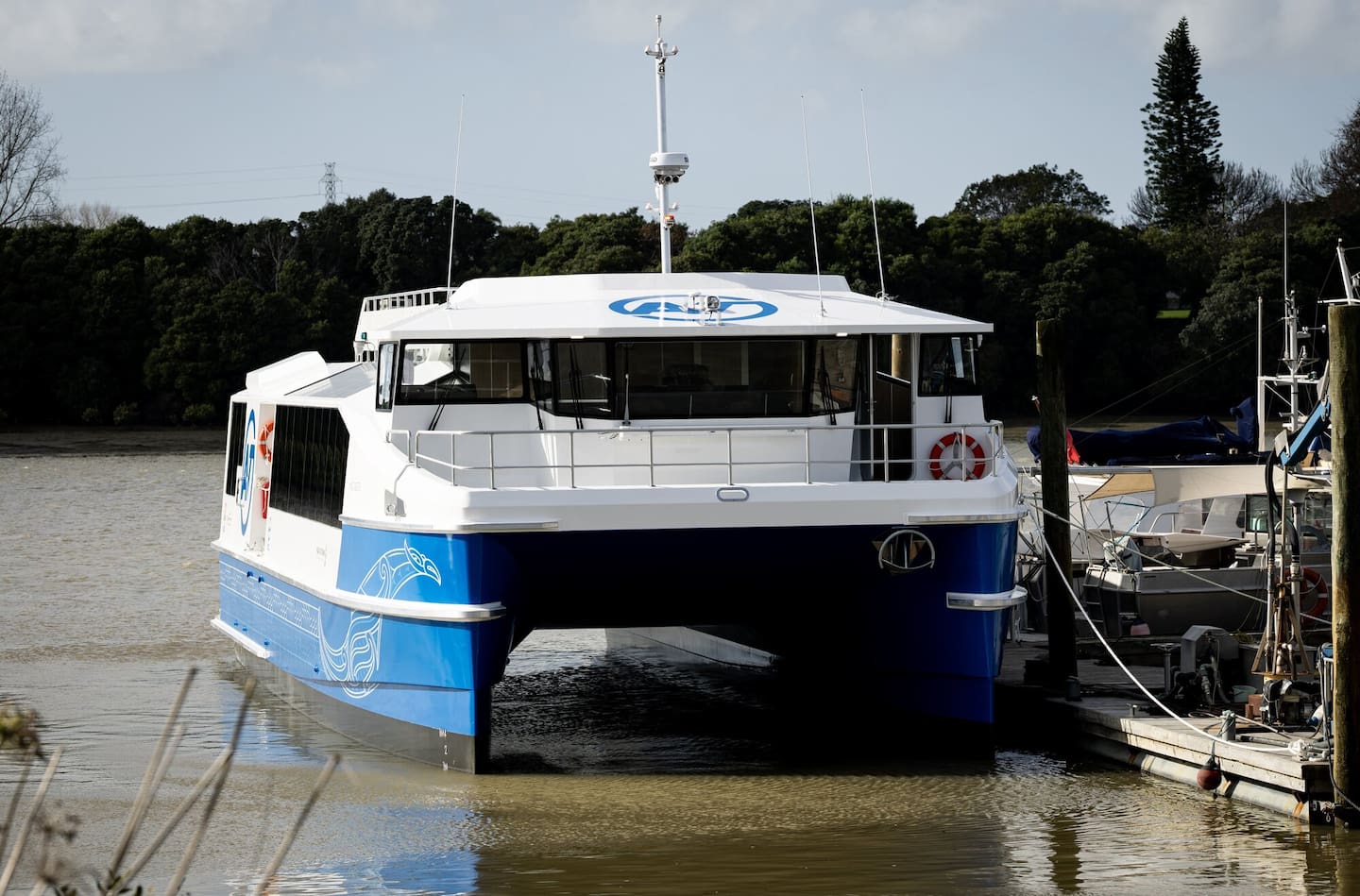
The return to diesel comes as AT’s first electric ferry undergoes tests on Auckland Harbour.
AT commissioned two 200-passenger, fully-electric ferries, at a cost of $20 million each, plus two 300-passenger electric hybrids with back-up diesel generators for the same price.
The first of the hybrids is also being tested on the water. The second electric boat and the second hybrid are due in months.
The Auckland Council agency originally planned to tender for three or four more electric vessels before the first wave were delivered.
But last year, a financial squeeze resulted in a deferral of funding for electric ferries.
And midway through this year, AT flagged its intention to switch back to diesel, which has been confirmed with the tender documents released this week.

AT board chairman Richard Leggat said in July, as councillors debated the switch, “It comes down to dollars”.
Leggat also raised reliability issues at the same meeting, saying, “If we have a ferry out [of action], we lose consumer confidence.”
EV Maritime chief executive Michael Eaglen says all the data available points to electric ferries – while having a higher upfront cost – being much cheaper to run and more reliable.
Eaglen, as the head of EV Maritime – the designer of Auckland’s first two electric ferries – obviously has skin in the game.
But he has an ally in Fuller’s chief executive Mike Horne, who has said electric ferries make the most commercial sense. And Horne’s not saying that as a greenie.
Fullers is controlled by a private equity firm – often regarded as the bluntest, least sentimental form of capitalism.
However solid the electric ferry data from Scandinavia and elsewhere in the Northern Hemisphere is, though, there has been a clanger closer to home.
New Zealand’s first electric ferry, the $12m Ika Rere, went into service in Wellington in March 2022.
But in September the same year, it broke down in the middle of the harbour and had to be towed back to shore by a police launch.
Diesel boats break down too, as Auckland commuters are keenly aware, but worse was to follow when Ika Rere suffered a mechanical fault in July 2024. It wasn’t back on the water until May this year. A parts shortage was blamed.

Horne said the Wellington electric ferry had been constructed through “a really bespoke process”, while Fullers has been working with Whanganui’s Q-West (builder of the two hybrid ferries) and Christchurch’s HamiltonJet (maker of the propulsion systems for the two hybrids and the two electric ferries) over three years “and at every point we’ve been looking at the viability of specific parts”.
He added: “And I’m not saying that as a boat builder chasing unicorns but as an operator of 40 years who knows exactly what we need to run big boats reliably.”
The on-pier charging system was being built to a global standard, Horne said.
Electric ferries ‘unproven’
“AT remains committed to the transition of our ferry fleet to low-emission vessels. We have procured two fully electric and two hybrid electric ferries, together with supporting landside charging infrastructure at Half Moon Bay and Downtown,” AT infrastructure programme director Nathan Cammock told the Herald.

“Electric ferries typically have a long lead time for construction and are currently targeted for shorter inner- and mid-harbour routes supported by landside charging infrastructure.
“Once the new electric vessels are in service, the new technology will take time to be proven and optimised. We anticipate 12 to 18 months for this phase.
“Until electric ferry technology is proven and further landside charging infrastructure is funded and rolled out, diesel ferries will still be required, particularly for longer routes.
“As an interim solution, we are planning to purchase three new diesel ferries to service longer routes and to serve as back-up vessels to the wider fleet. We expect these vessels to be delivered in mid-2028.
“These vessels will help avoid degradation of passenger services due to vessel breakdowns, and to reduce costs associated with more frequent and expensive vessel maintenance.”
All sides of the debate agree that diesel ferries are the cheapest option in terms of upfront costs.
A new high-tech business for Auckland?
Eaglen says it should also be borne in mind that replacing all of Auckland’s 30 public ferries with electric boats would help foster a new, export-friendly industry – and his firm has already parlayed its initial electric ferry business with AT into a contract on the US West Coast.
Is that something that would appeal to Mayor Wayne Brown, who won re-election on a platform that included a pledge to be a “high-tech” leader who helped boost the technology sector in the city?
How does that gel with the city’s throwback to diesel?
Brown’s office declined comment.
We have heard various AT board members and councillors gleefully jump on the Wellington electric ferry’s woes. But that goes with the territory if you’ve got a genuine desire to create new high-tech industries and gain a first-mover advantage for your city
When will the first electric ferry be on the water?
Aucklanders could expect to see the city’s new ferries on the Waitematā in the new year as operator Fullers put them through their paces, Cammock said.
But in terms of commercial launch, “We don’t have a firm entry date into passenger service for the low-emission ferries yet, as there is a significant amount of work still required before this is confirmed,” Cammock added.

“This includes the completion of vessel testing by the manufacturers, completion of sea trials and AT acceptance of each vessel once fully proven.
“There are also the matters of operator [Fullers] familiarisation with the vessels, crew training, and obtaining all required maritime approvals required for carrying passengers to consider.”
Ferry terminal chargers nowhere near
Swedish multinational ABB won a $27.6m contract to build on-pier chargers for Auckland’s new electric ferries at three locations:
- The Downtown Ferry Terminal on Queen’s Wharf – three 3.3 megawatt berths
- Hobsonville Point – one 2.2MW berth
- Half Moon Bay – one 3.3MW berth
Under the original plan – before resource consent hold-ups – they were supposed to go live between July and December 2024.
The Hobsonville Point charger, which will require a new pontoon, has now been pushed out to some point later this decade. Only preliminary scoping work has been done.
The Half Moon Bay charger is nearly ready for service, but Horne has said Fullers needs a charger at both ends of the Half Moon Bay to Downtown run (or any other route) to enable 10-minute top-up charging for continuous service as two ferries criss-cross, as per his company’s standard operation model.
And the issue there is that the space on Queen’s Wharf that will host the two-storey Megawatt Charging System – the centrepiece of the city’s new ferry charging system – is bare.
The Herald asked Cammock for a charger update earlier this week.
He said: “Construction works on the Downtown ferry charging is under way under Queens Wharf and will become more visually evident in the new year once the above-wharf works commence to install the charging equipment.”
Inside (and outside) Auckland’s first electric ferry pic.twitter.com/EvaxoNDTM8
— Chris Keall (@ChrisKeall) June 11, 2025
Brian Perry Civil is the head contractor for Downtown and the charging equipment will be provided by ABB.
“The charging equipment provider and contractor are the same as the equipment successfully installed at Half Moon Bay,” Cammock said.
He added, “Half Moon Bay will be the primary location for the testing, commissioning, and charging of our new electric ferries in Auckland while Downtown is constructed.”
When would the giant Downtown Ferry Terminal charger building be finished?
“We don’t have a firm date yet, as construction contracts and timelines are still being finalised,” Cammock said.
Chris Keall is an Auckland-based member of the Herald’s business team. He joined the Herald in 2018 and is the technology editor and a senior business writer.